Blog Detail

10 Sep
Premium Basmati Rice Exporter | From Punjab to Global
The Basmati variety of rice produced in India is renowned all over the world for its aroma, long slender grains, cooking properties, and elongation. The process of exportin premium Basmati rice from India entails being aware of all processes right from acquisition of the rice paddy till shipping.
Why Punjab Matters in the Basmati Journey
The state of Punjab is among the regions growing Basmati in India's geographical indication. According to APEDA, Punjab, Haryana, Himachal Pradesh, Uttarakhand, Delhi, certain districts in Western Uttar Pradesh, and certain districts of Jammu and Kashmir fall under India’s GI region for Basmati rice.
But being in the right place doesn’t mean that the rice will be good quality. What really sets it apart is the process of procurement, grain selection, modern milling and sorting. This is where a trusted Premium Basmati Rice Exporter from India steps in.
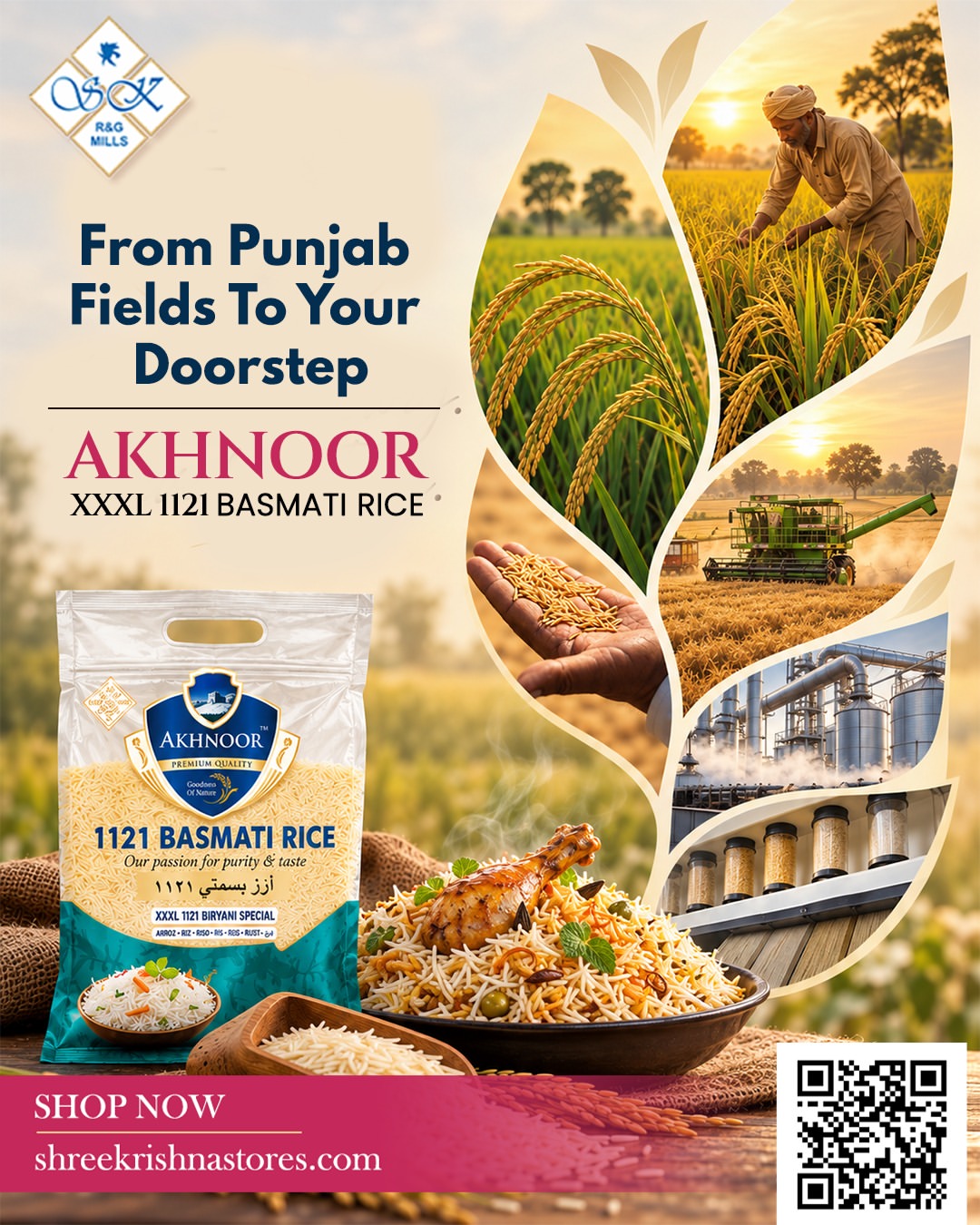
From Paddy Fields to Export-Ready Rice
Paddy arriving at the exporter's end is checked for variety, moisture level, grains, purity, and other factors that both the parties agree on. This is followed by cleaning of the paddy, destoning, dehusking, polishing, grading, and sorting of the paddy. Depending on the needs of the customers, the rice can be supplied in raw form, steam form, creamy sella form, and golden sella form. Various methods affect the quality of the product. The best way would be to try cooking some sample of the product and observe various factors.
Understanding Major Basmati Varieties
Some varieties of Shree Krishna’s rice are 1121, 1509, Pusa, 1401, 1718 and 1885.
One notable variety is 1121 because of its elongation property after being cooked. 1121 is famous in the preparation of biryani, especially when presentation becomes a consideration.
Another variety of importance is 1509. As per ICAR, the Pusa Basmati 1509 is an early-maturing variety whose maturity period is about 115 days.
Other varieties available include Pusa, 1401, 1718 and 1885. There is need to understand the cooking requirements, buyer's expectation, budget and the type of grain before purchasing any variety of basmati rice. This becomes the mandate of Premium Basmati Rice Exporter in India.
Why Processing Type Matters
Processing leads to varieties having different properties. White or unprocessed rice undergoes processing and not parboiling. Steamed rice goes through a steaming process while the Sella varieties are parboiled. The Creamy Sella rice usually ends up white and hard after cooking. Golden Sella rice usually appears golden and the choice of this variety depends on strong and attractive grains.
To importers, it is very vital that they request for a sample prior to purchase. The sample has to be analyzed for cooking period, elongation, aroma, separation, fragmentation, and appearance.
What Constitutes an Effective Exporter?
To be an efficient Premium Basmati Rice Exporter, one requires knowledge as well as consistency. Especially in terms of consistency. As per the Basmati Export Development Foundation at APEDA, the following activities can be included in this regard. Being consistently good is far more important than having just one perfect sample. The international buyer wants consistent performance to the agreed specification for all orders.
Buyer Checklist Before Ordering
When selecting any exporter of premium basmati rice from India, one should ensure that:
Nature of the product and the method of its manufacture is known.
Testing samples are requested from the most recent consignment.
Length of the grains and other quality aspects are ascertained.
Guarantees of the moisture content and similar parameters are received.
Packaging material and private labeling are known.
Order quantity is known.
Information regarding pre-shipment inspection and quality control is known.
Knowledge of export documentation and market requirements is obtained.
Landed cost, rather than just rice cost, is considered.
India’s Global Basmati Opportunity
India is one of the stakeholders of international business in connection with the exportation of Basmati rice. According to APEDA, India exports 6.52 million metric tonnes of Basmati rice in 2025-26. This is worth US$ 5.67 billion. The main buyers of the goods are Saudi Arabia, Iran, Iraq, UAE, Yemen, and USA. As one of the Premium Basmati Rice Exporters in India, quality is very important.
Key Points
- Selecting a good exporter will not only be done on basis of quotations. One needs to take into account sourcing, appropriate variety, processing, grading, packaging, inspection, and exporting.
- Sourcing of Basmati rice starts from Punjab. Being a Premium Basmati Rice Exporter in India, it is important that the exporter maintains the quality through the whole process.
- Information about variety and processing of the product will ensure the purchase.
- Testing of samples and making requirements will help in maintaining uniformity.
Frequently Asked Questions
1. What kind of Basmati rice should be exported?
1121 for extra long variety and 1509 is versatile enough to suit various requirements of the customers.
2. Why is Punjab needed for Basmati rice?
The answer to why Punjab is needed for Basmati rice is that Punjab is one of the geographical areas of India where the system of farmer, procurement, rice mills and exporter exists.
3. What are the differences between Steam rice and Sella Basmati?
Both Steam rice and Sella Basmati rice are unique varieties.
4. What are the aspects to take into account while assessing a rice exporter?
Rice type, specifications, sample, quality control, packaging, documentation, production, communication and regular shipment.
5. Is it necessary for buyers to conduct a sample test before purchasing in bulk?
Yes. It will show differences in cooking aroma, elongation, texture, separation, cooking time and breakability of the samples.
6. Apart from price, what other criteria does the purchaser need to take into account?
Quality specifications, processing, packaging, uniformity, documentation, shipping conditions and landed costs.
7. Is Indian Basmati useful for foreign food manufacturers?
Yes. Indian Basmati rice is exported worldwide and consumed by retailers, food services, restaurants, distributors and importers.
Recent Post
Partner With Us
Please fill out the form below and we will get back to you as soon as possible to discuss partnership opportunities.